Climbing California’s Mount Shasta

Climbing Mount Shasta is the goal of many an aspiring mountaineer. Soaring to 14,179 feet right above busy interstate 5 in the Southern Cascades near the Oregon border, Mount Shasta is California’s 4th highest peak and holds the state’s largest glaciers. From any aspect it is an impressive sight to behold, a mountain that is actually larger in mass than Washington state’s Mount Rainier.  Standing atop Shasta, “the Everest of California”, is an experience all will deeply appreciate, from the first timer to the most jaded of alpinists.

 
Mount Shasta

Mount Shasta


Mt. Shasta is actually three mountains in one…geologically. A large stratovolcano, the three mountains that have developed over the millennia include Shastina (the Cascades 3rd tallest peak) and two peaks that make up the main bulk of Shasta. While still considered an active volcano, Mount Shasta has not had an eruption since probably 1786 when a French ship off the coast of Northern California recorded in its ship’s log a large mushroom shaped cloud in the vicinity of Shasta. Today, the only volcanic activity you’re likely to see on Shasta are the hot springs near its summit. 

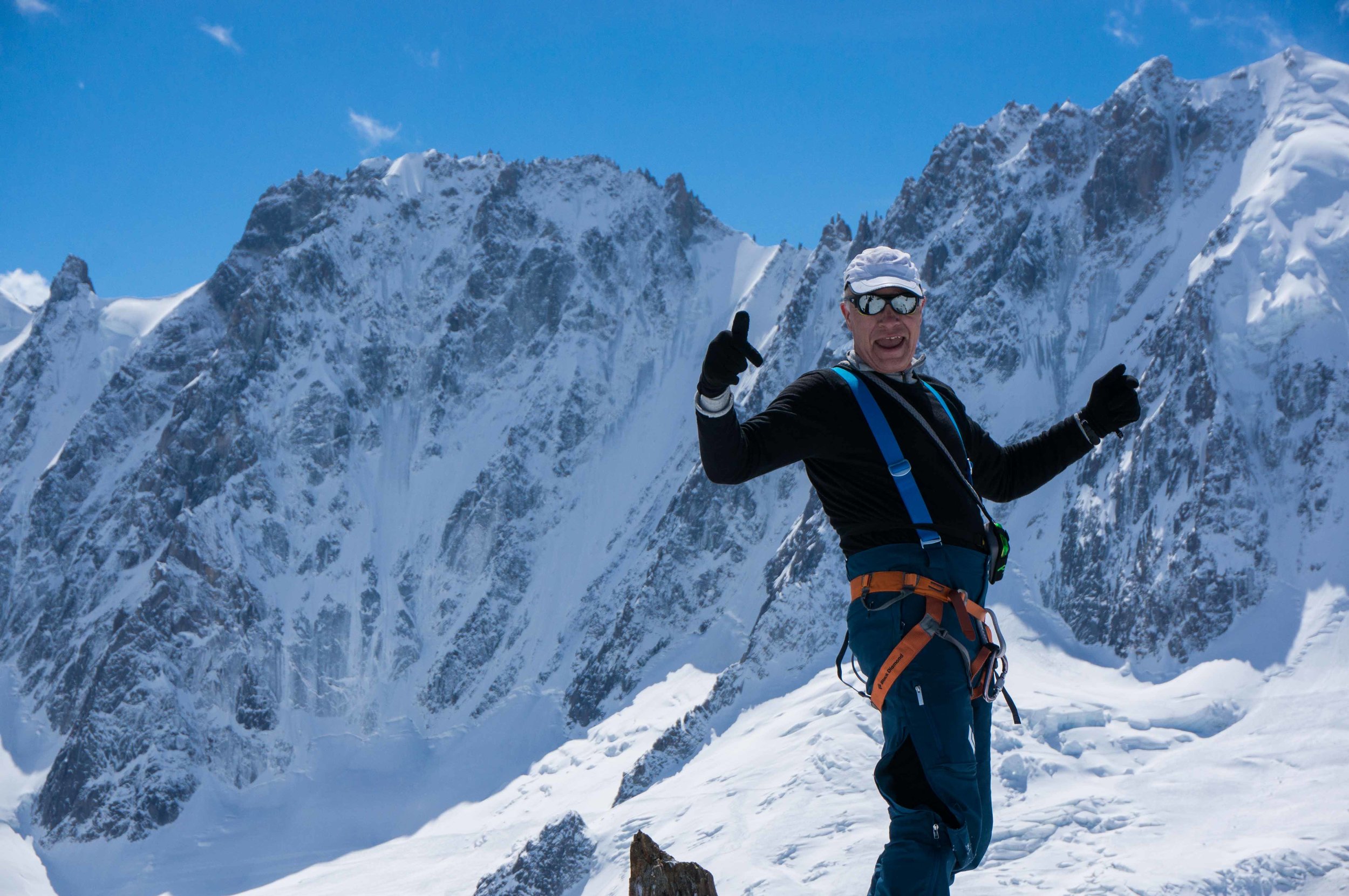
On the summit of Mount Shasta, 14,179 feet

On the summit of Mount Shasta, 14,179 feet

The lore of Mount Shasta runs deep, right into the center of the mountain in fact. Legends dating back to the 1800s have it that a race of people called the Lemurians have taken up residence inside Mount Shasta. As the story goes, the Lemurians lived on the ancient continent of Mu in the Pacific Ocean and in an Atlantean style disaster, the entire continent was lost to the sea and all with it. Only the Lemurians had the foresight to see the impending cataclysm and escaped in the nick of time to North America, and then right into the bowels of Mount Shasta where they founded the city of Telos. Whether you believe the myths or not, it is generally agreed upon that Shasta is home to odd and sometimes unexplainable activity. Many spiritual groups flock to Shasta each year to pay homage and experience the mountain’s energy.

 
Spring Basecamp in Hidden Valley, below the West Face of Mount Shasta

Spring Basecamp in Hidden Valley, below the West Face of Mount Shasta


Climbing Mt. Shasta’s snowy flanks is what attracts the most attention during the late Spring and early summer months. The mountain is considered one of the best entry level true mountaineering experiences in the United States. With a non-glaciated South side, Shasta offers beginner big-mountain snow climbing routes without the added hazards of crevasses and ice falls.  But that doesn’t mean it’s an easy climb! With over 7000 feet of vertical gain from trail head to summit, even the standard Avalanche Gulch route can be very strenuous and it requires stamina, good mountain sense and the use of ice axe and crampons… along with the skill and knowledge to use them safely. 

Avalanche Gulch is Mount Shasta’s standard and most popular climbing route. It was first climbed in the nineteenth century by none other than John Muir over an epic two days in which he almost didn’t make it down alive (a common occurrence for Muir). Trapped alone by a sudden blizzard on the summit, Muir was forced to take shelter overnight in the warmth of the hot springs near the summit. Today, Avalanche Gulch is climbed successfully each year (with no hot spring baths) by hundreds of people each season. Most Avalanche Gulch climbers will pass by the Sierra Club property at Horse Camp, which offers a great lower basecamp and a historical cabin to check out. Higher basecamps on the route include the well-known Helen Lake, which really isn’t a lake at all. Legend has it that an early guide on Shasta was asked by his client, a woman named Helen, what the name of the nearby lake was. Glancing over at the unnamed “lake” which was really just a seasonal snowmelt pond not worthy of a name, he quickly replied “why ma’am, that is Lake Helen!”. 

 
Climbing high on the Avalanche Gulch route of Mount Shasta

Climbing high on the Avalanche Gulch route of Mount Shasta


 The West Face climbing route on Shasta is just a small step up in difficulty and is another entry-level route the mountain has to offer. It has a more sustained steep section than Avalanche Gulch and a more remote basecamp in the beautiful Hidden Valley. The West Face is also Shasta’s most popular ski descent. Many people choose to climb these two Shasta routes as their first big-mountain route without the assistance of a mountain guide, but many also choose to join a guided group to increase the chances of summit success while decreasing the risk considerably. On normal snow years, the West Face and Avalanche Gulch routes can get quite melted out and riskier to climb by the end of July due to a larger chance of rock fall. It is not generally a good idea to climb either of these routes when their steeper sections are completely free of snow.

 
Climbing the upper West Face of Mt. Shasta

Climbing the upper West Face of Mt. Shasta


Another Shasta climbing route of note is the Clear Creek route on the mountain’s East flank. Clear Creek is actually the lowest angle and least technical route on the mountain (a horse once climbed it) and can be a good choice after the snow has melted off the South side routes. However, it departs out of a remote trail head and requires good navigational skills to avoid getting lost. Later in the season most of the Clear Creek climb may be snow free and may only require the occasional use of ice axe and crampons if at all.

 
Climbing Shasta’s Clear Creek route later in the summer.

Climbing Shasta’s Clear Creek route later in the summer.


Beyond Avalanche Gulch, the West Face and Clear Creek, the remaining climbing routes on Mount Shasta jump up quite a bit in difficulty and are only appropriate for those with solid mountaineering experience or those accompanied by an experienced mountain guide. The North side of Shasta is adorned with large glaciers complete with ice falls and hundreds of gaping crevasses. You’ll find all the glacial features on Shasta that you’ll find on the large glaciated peaks to the North such as Rainier and Mount Baker. The largest glacier in California, the Whitney Glacier, resides here as does the Hotlum Glacier which at least until recently was one of the only glaciers in North America that was actually still growing. While all climbing routes on Mount Shasta pass through federally designated wilderness, the North side takes that a step further. It is common to climb a North side route and see no other climbers. While the South side route can be out of shape by mid to late July, the North side routes can be quite climbable right into September. 

 
Climbing the Hotlum/Bolum Ridge on Mount Shasta

Climbing the Hotlum/Bolum Rodge on Mount Shasta


Popular North side climbing routes on Shasta include the Hotlum Glacier and the Hotlum/Bolum Ridge. An intermediate route, the Hotlum/Bolum Ridge carefully weaves a line between the Hotlum and Bolum glaciers and mostly skirts each one. It does require careful route finding, steep snow climbing techniques and enough mountain sense to know where not to go and when to turn around. Knowledge of crevasse rescue can also be important here and the route can get icy later in the season. It is a beautiful route with more exposure than the South side route and expansive views into two neighboring states. 
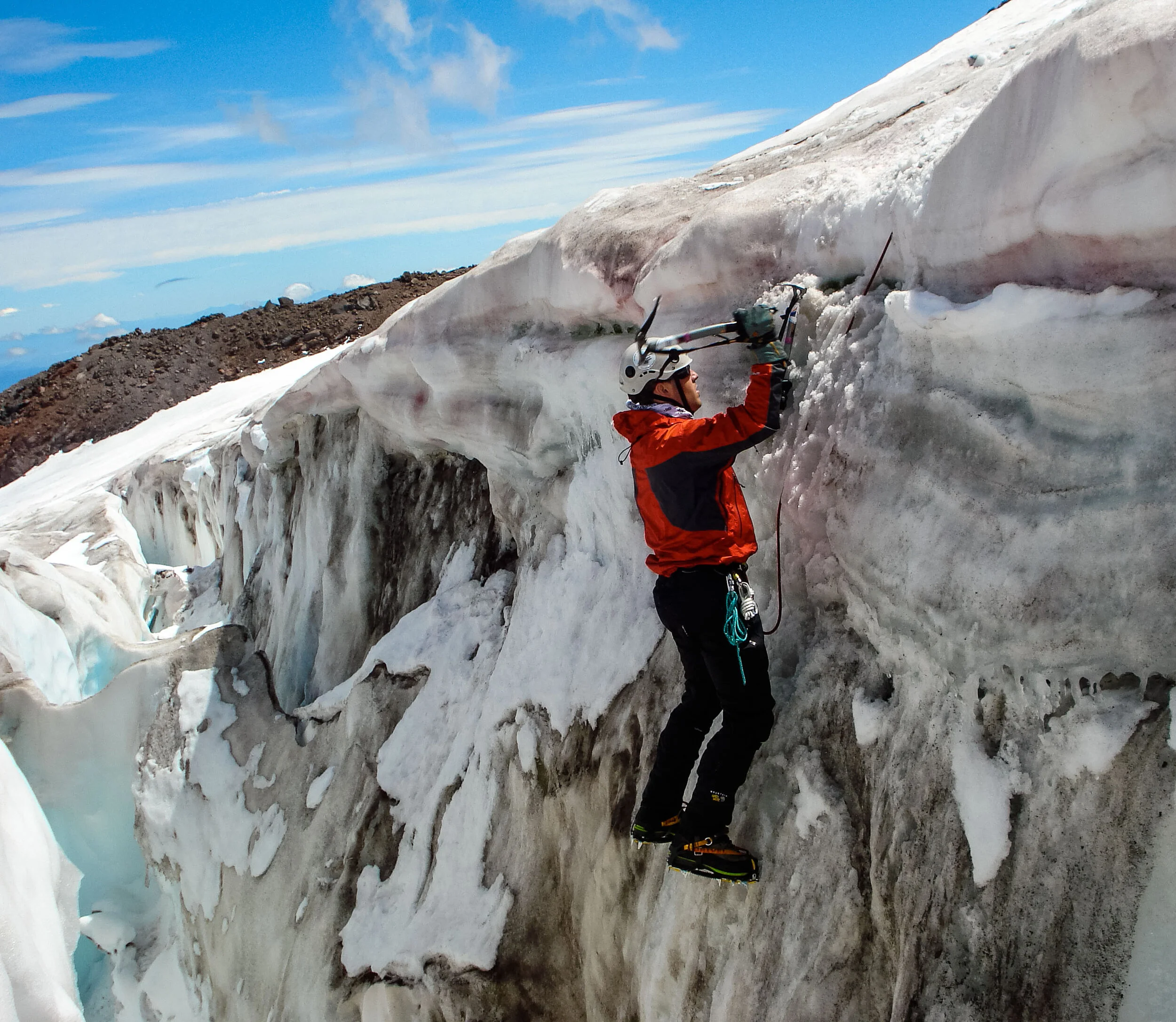
 
ice climbing out of a crevasse on Shasta’s Hotum Glacier late in the summer

ice climbing out of a crevasse on Shasta’s Hotum Glacier late in the summer


The Hotlum Glacier climb is quite clearly an advanced level Shasta climbing route. Featuring three ice falls and yawning crevasses over 100 feet deep, this is no place for those to venture without a guide unless you have solid glacier climbing and crevasse rescue experience. It’s also a fantastic climb and a great location to learn glacier climbing skills and crevasse rescue techniques under the tutelage of a professional mountaineering instructor. Weaving past the Holtum Glacier’s tall seracs (ice towers) and around its deep crevasses in the early morning light is an experience that will stick with you for a very long time.  The usual way to finish the Hotlum Glacier route is via the upper Hotlum/Bolum Ridge. The time of year for the Glaciated routes on Mt. Shasta is July through August after some of the winter’s snow has melted off the glacier and exposed a few of the crevasses.

 
Climbing past the ice falls on Mount Shasta’s Hotlum Glacier

Climbing past the ice falls on Mount Shasta’s Hotlum Glacier


For many, the real reason to climb up Mt Shasta is to ski down it. Mount Shasta is considered one of the top five ski mountaineering mountains in the world. In May and early June it is common to find 6,000 to 8,000 foot ski descents on the mountain, often with creamy corn snow. Famous ski routes are the West Face and the incredible Hotlum/Wintun Ridge, considered by many to be one of the top three ski descents in North America. Look for more on Mount Shasta skiing in a later article. 

 California, a diverse state that boasts famous beaches & vast deserts, also has excellent big mountain snow climbing and large glaciers to play on thanks to Mount Shasta. Shasta is a testament to the diversity of California. So if you’re a Californian looking for a true mountaineering experience to learn or hone the craft, there is no need to leave the state. And for those from elsewhere, Mt. Shasta is truly worth the effort as it is a word-class mountaineering and ski mountaineering destination. 

by IAG Owner/Director Dave Miller.
Dave has 20 years of guiding experience on Mount Shasta and approximately 80 Shasta summits under his belt.

 Looking for a guide on Mt. Shasta? Check out our many Mount Shasta Climbs, Ski Descents and Courses.

Backcountry Skiing Fundamentals: Properly hydrating and layering for a day in the backcountry

It is no secret that more individuals than ever will be ditching the resorts this winter and taking up backcountry skiing. Visions of chest deep powder amongst jagged snowcapped peaks in the solidarity of the high alpine is a major draw. Many newcomers to the sport are only vaguely aware of some of the risks involved in skiing off-piste in the backcountry and many will take an avalanche course. Students in a recreational level 1 avalanche course learn the basics about avalanche hazards, practice avalanche rescue and learn strategies to safely manage a group while skiing in the backcountry. Avalanche courses are considered a benchmark of safety standards for the backcountry skier and boarder.

If one plans to get the most out of an avalanche course, they should come into it familiar with some basic skills of backcountry skiing & boarding. Time on an avalanche course should be focused applying new knowledge of avalanche safety, not spending time learning how to use the equipment or layering techniques. Here, we will discuss some of the ”soft skills” of preparing for backcountry skiing, specifically hydrating a skier for a day of backcountry skiing and layering techniques used to keep them warm, dry and happy. Up ,and down, the mountain.

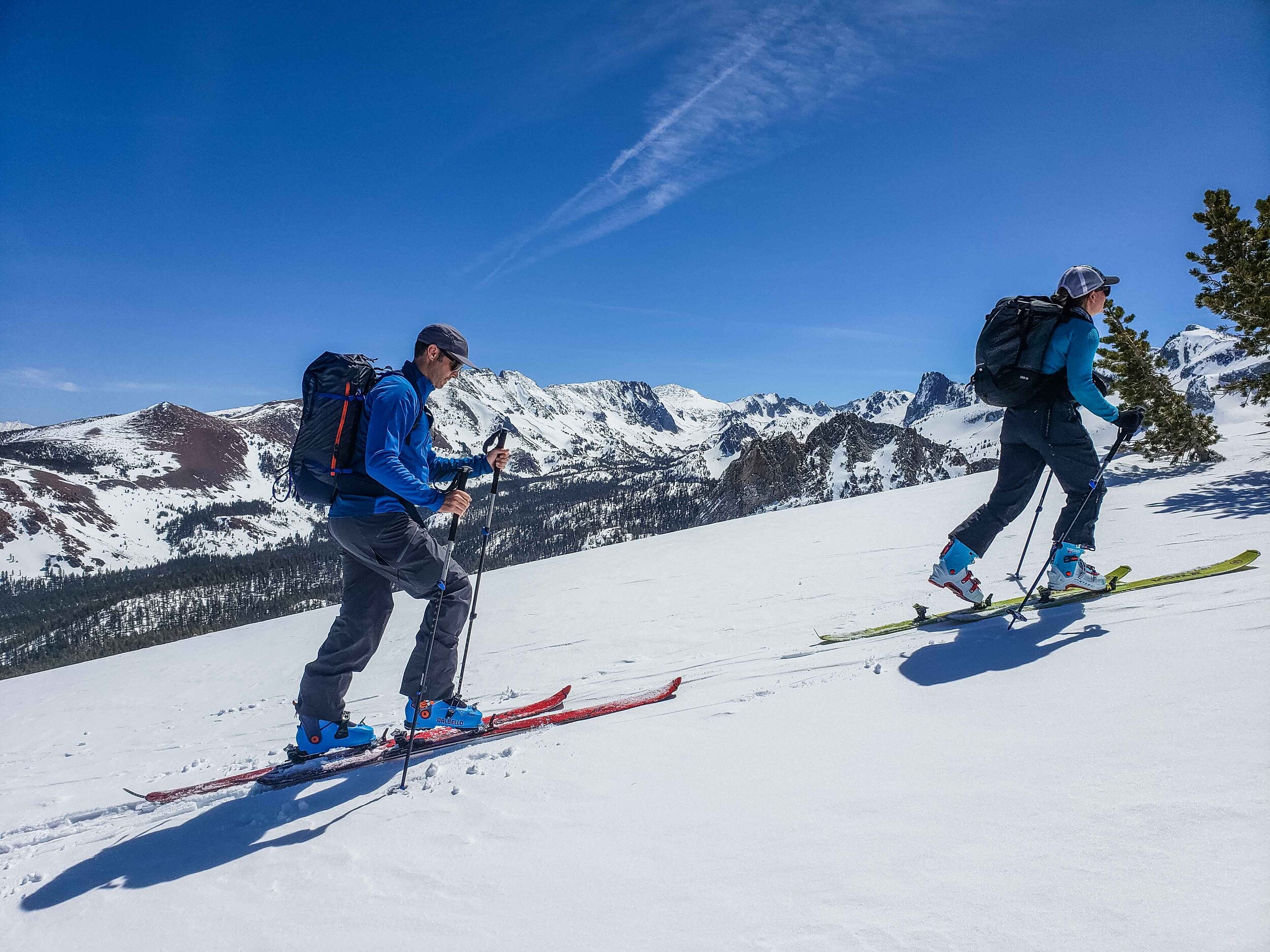
Ski touring in the backcountry

Ski touring in the backcountry

First and most importantly, make sure you have enough calories and liquids for the day of ski touring. North America is not known for its extensive backcountry ski chalets where one can pull over for a quick bite or a hot tea, one would need to travel to Europe for that sort of luxury. Backcountry ski touring is far more active than riding a chairlift. You will find yourself breaking trail and moving uphill at altitude, all while being exposed to the elements. Proper hydration and caloric consumption are key to comfort and happiness in the backcountry. On average, plan on having around 2 liters of liquid for a day tour, but may be adjusted based on weather conditions, proposed distance and vertical gain for a day and personal needs. This may be a mix of hot drinks such as coffee or tea, and water or some sort of hydration mix. Packing too much water for the day has a similar negative impact as not bringing enough as water is heavy. Some people spend thousands of dollars on lightening up their backcountry ski setup a few ounces with the idea of making the uphill easier, but then take no time to think about what they are putting in their pack and how much resistance this may add to the uphill.

The weight of your backcountry ski pack matters

The weight of your backcountry ski pack matters

Drinking from a hydration reservoir such as a Camelbak has become quite popular in recent years and has its advantages. The luxury of being able to take a sip whenever one desires is understandable, but I have found this to be an inefficient way to carry and consume water. Often individuals that use these systems are finished with their water for the day far too soon since its more challenging to monitor your consumption when its hidden somewhere in your ski pack. On cold backcountry days the hoses of these hydration systems can freeze, at a minimum causing a nuisance but also possibly rendering this system useless until heated. Additionally, then tend to leak at times and a leak of water into your pack is a quick way to impact your ski tour with wet layers. 

Another critical skill of an efficient backcountry skier is how to appropriately layer their clothing. The jacket and pants you bought for the resort are not intended for a backcountry skiing. Many are heavily insulated to keep you cozy while sitting on a chairlift. The savvy backcountry skier will carry a variety of different layers and will adjust their system based on time of year, length and difficulty of the ski tour and forecasted conditions. Its important to understand before you head out on a backcountry ski tour that you are likely to spend much more time walking uphill than skiing down. Being appropriately dressed for hours of aerobic activity is important, but so is the ability to add layers for an exciting ski descent or with the rapidly changing conditions experienced in the alpine zone. Appropriate protection from the elements can also save your life if things do not go as planned.

Backcountry skiing layers

Backcountry skiing layers

When layering, starting with a lightweight base layer next to the skin is nice for wicking moisture and keeping you warm while not cooking you on the uphill skin track. My ski pant decision generally depends on conditions as well. Consider wearing a softshell style pant.. These pants breath better than their waterproof counterparts, dry quickly and have good stretch for mobility. In drier, sunnier backcountry ski zones such as California or Colorado I am comfortable in a softshell most days. On colder, windier, wetter or deeper days, one may lean towards a non-insulated hard-shell style pant, ideally one with good venting zippers. Anything that is fully waterproof will breathe poorly, heating the skier up on the ascent which will quickly lead to perspiration that can chill you to the bone when you take break, or on the descent. A puffy highly insulated pant is a great layer to bring on overnight ski tours and on very cold day ski tours. I find myself wearing them during long transitions and lunch breaks, on colder descents or if my feet are feeling cold, they do a great job warming up the femoral artery and sends warm blood to the little piggies on my feet. 

Warming the core is also another moving target depending on conditions in the back country. A effective layering system has some general themes, starting with a light weight next to skin layer. Next comes a warmer, wool or poly-pro insulating mid-layer, such as a Patagonia R1. These two layers are mainstays in my system and worn almost every day out backcountry skiing. On clear days, I will sandwich a sun hoody shirt between these layers to limit exposure to the sun.  Layers on top of these are interchangeable but will likely include an insulating vest or synthetic lightweight puffy, softshell jacket, or a waterproof storm-shell. A critical layer that should always be in the pack is a warm down puffy jacket with a hood. I will put this on this during breaks longer than a minute of two to maintain any heat I have generated while motoring up the skin track. 

Hats and gloves for back country skiing

Hats and gloves for back country skiing

Critical accessories include ski gloves, hats and ski goggles. A variety of ski gloves can be useful. At a minimum, bring a lightweight, breathable softshell glove for the ascent, and for the descent, I brandish a pair of warmer more traditional insulated and waterproof ski glove. If gloves get wet, I toss them inside my jacket to use my body heat to try and warm them dry.  At minimum, this will help gloves from turning into a frozen cast and your body heat will speed up the drying process in the field. 

Protecting one’s eyes in the alpine zone on a ski tour is critical. Failure to protect your eyes can lead to strained and tired eyes, snow blindness, and more long-term issues that could warrant a visit to the optometrist. I try and wear a sunglass with good wrap coverage that will cut down UV reflection off the snow and does not allow light to sneak through the bottom or sides of your shades. Traditional “glacier glasses” is overkill, prone to fogging up due to poor ventilation and only allowing a small amount of visible light through, hindering your sight. Ski goggles will always end up in my pack, sometimes with both a high and low visibility lens, depending on weather conditions. But most of the time while backcountry skiing, I will only bring the low-visibility lens and use my sunglasses to protect my eyes on high visibility days.Frequently I opt for just the sunglasses on both the ascent and ski descent for ease and efficiency.

Backcountry powder skiing on a storm day

Backcountry powder skiing on a storm day

Additional cranial accessories include hats, helmets and neck gaiters. The ski helmet debate is something I leave to personal preference, and in recent years I have been more apt to wearing one for descents or when clear or overhead hazard is present such as rockfall. It is worth mentioning, most modern ski-helmets have added insulation and can overheat an uphill traveler. In most conditions, this guide prefers to wear larger brimmed ballcap and utilize the hoods attached to other garments already being worn. This protects against UV light and is a more easily adjustable. I also carry a knit hat, without a pom-pom if I plan to fit it under a helmet, for protection and warmth against harsh winter environments. Lastly, and perhaps most importantly, is the neck gaiter. The Buff brand neck gaiters are lightweight, moisture wicking and multi-functional. They may be worn just around the neck to help warm the jugular artery, this can help keep the face, neck and chest warm. This garment can also be pulled up over part of the face to protect in particularly cold backcountry conditions. 

One can easily discern there is not a “right or wrong” way to pack and layer for a day of backcountry skiing. It is nice to have a general system and be able to add or remove items based on conditions. Factors I often think about when preparing for a tour include weather, forecasted snow conditions, ski tour length, level of commitment and strenuousness, terrain type, skier ability, and personal risk-tolerance. My backcountry skiing kit is always fluid, as the season ebbs and flows. From the shorter, colder winter days of January and February to the longer, sunnier days of spring ski mountaineering, conditions will dictate my decisions. While one may have a few mainstays like a puffy jacket and sunglasses, and buff. It is worthwhile to always check conditions and make decisions based on your individual needs, the forecasted conditions and the proposed ski tour plan for the day. 

Looking for professional instruction in backcountry skiing & guided ski tours? Check out our:

Lake Tahoe Intro to Backcountry SkiingCourses & Guided Tours
Mammoth Lakes Intro to Backcountry Skiing Course & Guided Tours

by Kevin McGarity
IAG lead mountain guide

Climbing Mt. Whitney in Winter

Climbing Mt. Whitney is a goal of many hikers & climbers, and for good reason. At 14,505 feet It is of course the highest point in the continental United States. Every summer throngs of hikers, those who managed to win the lottery system for a permit, are to be found snaking their way up the famous Mt. Whitney trail. Climbing Mt. Whitney in the quiet winter months, however, is a far greater accomplishment than slogging up the trail in the dead of summer. The trail route on Mt. Whitney in the summer, which John Muir deemed appropriate “for the soft & succulent”, does not even compare to the challenge of a Whitney winter ascent.

 
winter alpenglow on mt. whitney and the needles

winter alpenglow on mt. whitney and the needles


First off, the regular Whitney trail route is not the preferred winter route due to the fact that there simply is no trail. It is buried under many feet of snow and the route the trail takes is longer and more exposed to winter hazards than the better option…the mountaineer’s route. First climbed by none other than John Muir, The mountaineer’s route up the North Fork of Lone Pine Creek on Mt. Whitney is shorter in distance and a little bit less prone to avalanche hazard than the trail route, but it does require solid mountaineering and winter travel skills.

The mountaineers route on Mt. Whitney requires the use of snowshoes, ice axe and crampons and, more importantly, the knowledge on how to use them safely. The route also goes through sections of avalanche terrain which requires one to be able to evaluate the stability of the snow and know when it is safe to travel. You also need to carry avalanche safety gear such as an avalanche beacon, lightweight backcountry snow shovel and avalanche probe. And of course, this gear is almost worthless without knowing how to use them properly and conduct an avalanche rescue. Having been through an AIARE avalanche 1 course would be the standard training anyone venturing into avalanche terrain in the winter on their own should have.

Winter mountaineering camping skills and winter camping equipment, along with proper winter clothing, are essential also. Temperatures can easily dip to subzero above 11,000 feet in the Sierra Nevada in the dead of winter. And then there’s the winter storms that bring with them very high winds that sweep Mt. Whitney during the winter months. Knowing all the soft skills such as proper camp setup, staying warm, melting snow for water and how to dry out wet clothes are key to your safety and enjoyment. 

 
winter camp at lower boy scout lake

winter camp at lower boy scout lake


Have I talked you out of it yet? Hopefully not, because with the proper knowledge, gear and preparation a Mt. Whitney winter ascent can be extremely rewarding. If you lack any of the above, but feel you have what it takes physically and mentally to take on such an endeavor, you can always hire the services of a professional mountain guide (more on that later). Without these skills, or the company of a professional, you just should not attempt a Mt. Whitney winter ascent.

Where you begin an ascent of Mt. Whitney in the winter months depends on how far the Whitney Portal road is open. But it’s best to plan on parking the car and strapping on the pack near the beginning of the first switchbacks on the Whitney Portal road at around 6600 feet. Once arriving at a deserted and snowbound Whitney Portal, things get real. The route beyond the Portal steepens and enters the narrow drainage of the North Fork of Lone Pine Creek. Depending on the current snowpack, snowshoes may be first needed from here. A heavy pack and occasional steep bushwhacking through this section can make one wonder what they’ve gotten themselves in to. Finally arriving at the flats around Lower Boy Scout Lake this is usually the best spot to toss off the packs and dig in to make the first night’s camp and take a well-deserved rest after a 3700-foot climb. 

While it is possible to go for the summit of Mt. Whitney from Lower Boy Scout Lake, most parties will choose to bump their camp higher. It’s easy to underestimate how long it takes to travel through a winter snowpack in winter conditions. A good goal for the second day is a camp somewhere between Upper Boy Scout Lake and Iceberg Lake, or even Iceberg Lake itself. Either of these options put you in a good position for the Whitney summit bid. Above Upper Boy Scout Lake you enter the true alpine zone well above tree line where the effects of wind and winter storms are amplified. This is the zone where it is crucial to be on your game. 

 
high on mt. whitney’s mountaineer’s route

high on mt. whitney’s mountaineer’s route


Summit day on Mt. Whitney is where true climbing skills come into play. Above Iceberg Lake the route steepens in the mountaineer’s route couloir. Depending on snow conditions, ice axe and crampons may be needed in the initial 35-degree couloir which leads to a notch. From the notch it’s true climbing and the steepness increases substantially. There could also be water ice in this section and roped belayed travel commonly comes into play here. Just as the route gets to its steepest point it suddenly flattens out and there you are on the summit plateau, a short easy walk to the summit hut and register. The views are expansive all around from the Owens Valley 10,000 feet below you to the East to the Great Western Divide far off to the West. 

 
the final climbing section before the summit plateau of mt. whitney

the final climbing section before the summit plateau of mt. whitney


 It’s also crucial to keep to a time plan on summit day and not get caught out in the dark between the summit and your camp. Once darkness sets in everything slows down and fatigue worsens. Best to always get back to the safety of your camp well before the sun goes down. And never climb into a worsening storm. But if you are caught out in a storm, having whiteout navigation skills and being good with map, compass and especially GPS is crucial to your safety.

After summit photos and a food break, it’s back down the way you came and back to camp for the night. The last day is all downhill back to your car where you leave the real world and enter civilization once again. All in all, a Mt. Whitney winter ascent is not easy, not always fun, and one of the most rewarding experiences you’ll ever have. 

 
view from the summit of mt. whitney in the winter

view from the summit of mt. whitney in the winter


Wilderness permits for Mt. Whitney are required all year but in the winter months from November 1st to May 1st there is no quota or lottery and permits can be picked up at the ranger station in Lone Pine. Climbing Mt. Whitney in winter with a professional mountain guide can add immensely to the enjoyment of your experience as well as your safety and success chances. And you can learn a lot for your future mountaineering trips as well. International Alpine Guides offers 4-day Mt. Whitney Winter Climbs from January through April. 

by Dave Miller

Dave is an IFMGA internationally certified mountain guide and the owner/director of International Alpine Guides. He has guided major peaks around the world from the famous peaks in the Alps of Europe to the 22,800-foot summit of Aconcagua in South America. He has over 80 summits of Mount Whitney under his belt. 

Always Be Prepared for your Adventure: First Aid Kits

Jessica DeMartin, M.A., RN
NOLS Wilderness Medicine Senior Instructor

Be prepared! We prepare ourselves for rain, snow, sun, with all sorts of gear and training. Though we can’t be prepared for every aspect of an outdoor adventure, a good First Aid Kit is one of the best places to start!  First Aid Kits are an easy way to be prepared for the most common and simple trail injuries even with minimal or no first aid training.

 
wfr-2189.jpg
 

Keep it Simple! Basic wound care is what First Aid kits are designed for. This means cuts, abrasions, blisters, sprains and strains, as well as insect bites, and stings. Wound cleaning is also very important aspect of first aid care in order to prevent infection. Only carry what you need and know how to use. Inventory your kit before you leave the trailhead to ensure you have what you need when you need it.

Trip Specific. Keep your first aid kit the size of the trip you are going on to assist the number of people on your trip. No need to bring an expedition sized backpack kit for a day hike with yourself. 1 set of wound dressings per person per trip is a great estimation of size.

 Waterproof- This is largely over looked with commercial branding of first aid kits. Many first aid packages (gauze, bandaids…) are not water proof. A zip lock bag is an easy way to ensure this. This will ensure your first aid supplies are dry and ready when you need them. Not to mention most first aid supplies are generally made to stick or absorb, if they get wet prematurely in a rain storm they will be no good when you need them. 

Have a Plan: First Aid kits are designed for small wound care. It is always recommended you have a greater evacuation plan in place in case something bigger occurs. This can include sharing your trip plan with others, checking in with local ranger stations, carrying an emergency locator device such as SPOT or InReach device, and taking a Wilderness First Aid class or Wilderness First Responder Class

 
wfr-2096.jpg
 

Here are some suggestions for basic first aid kit supplies: 

  • Band-Aids- the most common item requested, and used. Make sure your kit has selection of large and small ones.

  • Gauze pads- great for bleeding control and non- stick for wound dressings

  • Tweezers/small scissors- for splinters, and cutting bandages, tape…etc.

  • Athletic Tape- great for securing larger bandages, or taping an ankle. This is one of the items I wouldn’t leave home without. You can do almost anything with it!

  • Wet Wipes- for wound cleaning, hygiene, and hand cleaning.

  • IBU/Tylenol- for pain control, sprains strains Benadryl- an antihistamine for allergic reactions, and to help you fall asleep.

  • Antibiotic ointment- cover wounds with them before applying a dressing to prevent infection (of course take all medicines as recommended, if you’re not sure check with your doctor).

  • Ace Wrap- applies compression and support to various musculoskeletal injuries.

  • Roll Gauze- Great to wrap a bandage around a wound such as a finger, foot or elbow.

  • Gloves (Nitrile)- medical gloves for assisting with care of any body fluids

  • Hand Sanitizer- for good hand hygiene before and after first aid care.

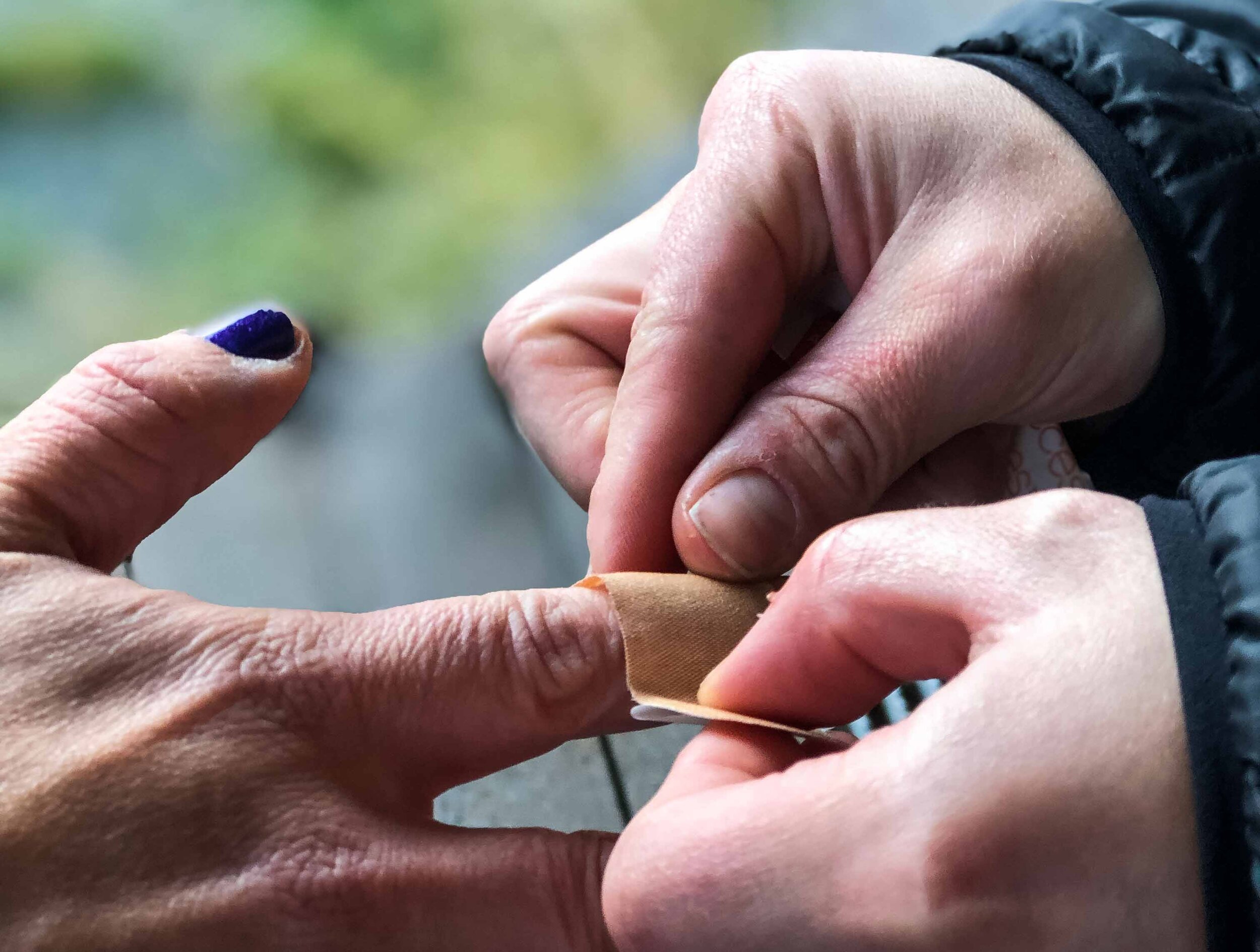
  • Blister Kit- Friction blisters caused from your toes rubbing along your boot, or hang gripped on a paddle can be treated with items in your blister first aid kit such as Mole Skin or Mole Foam, there are also a number of commercial bandaid products like Bilsto Ban and Kinesio Tape that helps to take the friction from rubbing on your skin and instead onto the dressing. Pro Tip! Duct tape is NOT recommended for use on skin. For Duct Tape lovers of the world, there is medical brand duct tape which won’t adhere to your skin with harmful chemicals like commercial brand duct tape.

 (Don’t forget an small Ziploc bag for all the micro trash that comes from these products).

 
wfr-2093-2.jpg
 

 If you want to learn and practice more skills you can also take a Wilderness First Aid Class. International Alpine Guides sponsors both Wilderness First Responder and First Aid training. If you are interested in taking a course through NOLS Wilderness Medicine with senior instructor and Emergency RN Jessica DeMartin please contact us!

Skiing Alps of Europe: Freeride, Ski Touring & Ski Mountaineering

Skiing Alps of Europe: Freeride, Ski Touring & Ski Mountaineering

The Alps of France, Italy, Austria & Switzerland are an almost mythical place in the minds of skiers and climbers. The birthplace of alpinism and ski mountaineering with a rich ski culture all to its own, the Alps should be on the list of any serious backcountry skier.

Read More

On The Road...

IMG_5441.jpg

The open road inspires many to think, write, and sing songs about travel, the adventure of new and different places. It brings the hope of mile after mile meditation, problem solving, and deep inspiration in which the day-to-day gets further away and into the present moment of exit signs, new landscape, funny billboards, the sun in your eyes, passing art cars, and RVs. The road trip is the first to do on many well seasoned as well as not so seasoned travellers bucket lists, but how many take the step and embrace the open road?

Despite how much I have travelled the world, and understand the fundamental gift it gives to my life, I always struggle to leave the comfort of home because of that one last thing that has to be done. Yet the journey calls. The newness of a trail not yet walked, a climb not yet climbed, the smells, the feeling of being in a different country yet in your own country. That painful, uncomfortable feeling of walking out of your comfort zone is the very thing that shatters our perspective and sometimes reinforces often what and who most important. The whole thing is travel.

10 days ago we left home and immediately found ourselves trapped in Suburban California gridlock, desperately grasping at any open country road to get us through the unexplainable traffic jam as we made every effort to escape and begin our trip. Today we are holed up in a rain storm after spending days rock climbing across the West, visiting battlefields, and walking in the shoes of Wild Bill Hickok. 

“Why would you leave California and Yosemite” many have asked us. We smile make small talk, answering endless questions about our most famous travel companion- the Sprinter van. What I want to say is it is, we are on a quest to refresh our love of rock climbing, find new climbs, be in a different routine, eat new food, see new forests, new landscapes. “This is why” I simply say and point to something beautiful. 10 days later I encourage all to simply leave the day to day in any way, that important thing will most surely be there when you return, the process of disconnection reconnects us to what and who is most important

Last week the world lost Anthony Bourdain who inspired a world to travel more and find oneself in the most improbable aspect of a travel experience. He encouraged the fundamental and basic aspect of travel- to simply move. He wrote in his book No Reservations- “The journey changes you. It leaves a mark on your memory, on your consciousness, on your heart, and on your body. You take something with you, and hopefully leave something good behind”. 

May we all travel more, leave behind the day to day, embrace the inner wild in us all, use work as a means to fund the adventure that grows your soul. 

From a coffee shop in Western South Dakota, on borrowed internet…. Yosemite Jess R.N.

Ice Climbing in California

California has the best and most consistent ice climbing on the West coast. A bold statement, but of course there isn’t a lot of competition! While it doesn’t quite compare to Colorado, Wyoming or Canada, California has a lot of what water ice climbers are looking for: long water ice flows that last for months. But where do you find these Golden State gems? Following is a sampling of California's water ice climbs.

ice 1.jpg

Eastern Sierra
The cold, shady canyons of Lee Vining and June Lake hold some high quality ice flows from around mid-December till mid-March. In Lee Vining canyon you have two flows that are consistently formed each year, Chouinard Falls and Main Wall.

Chouinard Falls is about 110 ft high and is mostly rated Water Ice 3 which makes it a great beginner to intermediate top rope flow and good for intermediate climbers to test their lead skills. About 100 ft away is the Main Wall and is about 200 ft in height and has some great climbs from WI3 to WI5. Advanced ice climbing leaders can test their skill on classics such as Cave Man and the mixed classic Heal Toe.

The June Lake Loop area has two areas that are just perfect for beginners. The Roadside area known as, well, Roadside is the perfect angle of about 65 degrees for first timers. Farther up the mountainside you’ll find Horsetail Falls, which is much longer, up to 200 ft, and right about 60 degrees also. Both are great areas to try out the sport of ice climbing.

Lee Vining and June Lake is where you will find guided beginner ice climbing courses in California.

ice.jpg

Sequoia National Park
While the Eastern Sierra has most of the water ice climbing in California, and certainly the most consistent, there are some other areas worth mentioning. Down to the South in Sequoia National Park near Lodgepole you’ll find Tokopah Falls, which makes for great top-roping. Near Tokopah is the Watch Tower, an impressive 1100ft ice WI4 ice climb. Both of these areas may not hold good ice all winter though so you have to hit it when it’s in.

Lake Tahoe Area
To the North in the Lake Tahoe area there can be good ice climbing in the Emerald Bay area such as at Eagle Lake. Near Truckee, Ca. you’ll find Coldstream Canyon with good ice flows on some years but it does have a long approach. Lake Tahoe ice can be good, but on mild winters it can also be non-existent.

Yosemite Valley
And then there’s the grand dame of them all, The Widow’s Tears in Yosemite Valley. Said by some to be the longest water ice climb in North America, Widows Tears is approx. 2000ft of some thin, some fat, and sometimes some very scary climbing. It doesn’t form often, maybe every 3-5 years or so, but when it does it can cause quite the stir in the local ice climbing community.

So in a state known mostly for beaches, movie stars and big cities, it is possible to find some amazingly good ice climbing. California is quite the Dichotomy.

Check out our winter 2016/2017 ice climbing & winter mountaineering courses in the Eastern Sierra! 

Dave Miller
IAG/CAG owner/director
IFMGA internationally licensed mountain guide

The Haute Route Ski Tour Takes All Kinds

By Jed Porter, IFMGA Ski and Mountain Guide

The Haute Route takes all kinds. All kinds of skiers. As a bucket list” adventure for an entire world of ski fanatics, the backgrounds of her suitors are varied and interesting. Many are curious about what it takes to do the deed. The most recent IAG Haute Route trip and group were fairly representative. We had strong downhill skiers, varied touring experience, and the entire spectrum of ski mountaineering conditions and weather. We did not complete every single section of the route, but that is far from the only measure of success up there. If you expand your definition of the Haute Route to its broadest terms, it is skiing, wine, and culture. We had all that, even without visiting the final hut or making the final ski descent. 

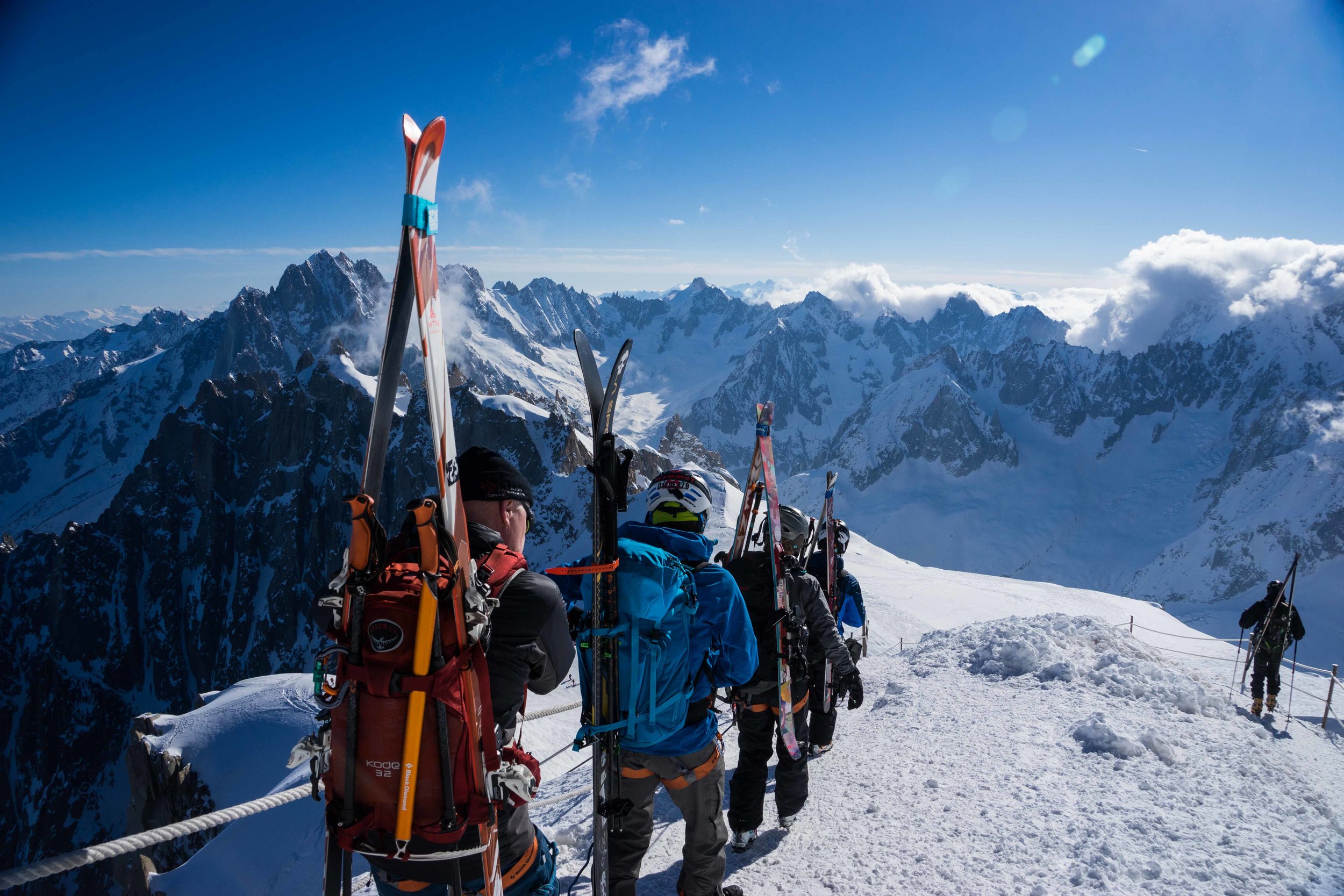
The team exiting the aiguille du MIdi in chamonix

The team exiting the aiguille du MIdi in chamonix

Whether you are just curious, or wish to calibrate your own preparedness, a little profile of each skier on this particular trip is apt to be interesting. Here’s the team. 

John is a 60-something physician from New Brunswick, Canada. He’s been a Maritimer” (Canadian slang for those living in the eastern coastal provinces) all his adult life, except for that one winter ski patrolling out at Apex Mountain in British Columbia. John is the ultimate bucket lister”. He’s done it all, seen it all. He’s sailed across oceans, taken up dancing as an adult, slogged through Quebec’s Chic Choc mountains, and taught some of the first ever wind surfing classes in the ‘70s. He ice skates and cares gently and effectively for other rural Maritimers. Prior to the Haute Route, however, John had basically no backcountry experience. In what is one of my favorite new phenomenons in the backcountry skiing world, John did his training by skinning up his local Crabbe Mountain ski hill. Backcountry skiing is a complicated beast. There is the uphill, the downhill, the equipment, and the hazards. Most aspiring backcountry skiers have the downhill portion pretty well sorted out. Learning the skills for ascending on skis is best done in a safe, familiar environment. More and more resorts allow uphill traffic, and more and more skiers are participating. This allows people to skin where they already know where to go, to skin where it is at least relatively safe to do so, and to skin sometimes on man-made snow when there is no snow in the wild. It’s brilliant. A number of times in recent years we have had folks just like John dedicate months of preparation for the uphill portion of a backcountry trip completely inside a ski resort boundary. John’s preparation paid off. He won’t say it was easy, but he had what it took to complete each day with enough energy to find the next wine glass. That’s success!  

John is loving it!

John is loving it!

The Haute Route was Scott’s first guided ski adventure, ever. The same could be said of other participants on this trip, but it isn’t as notable as it is for Scott. Scott has been skiing the backcountry for about 20 years. He is a competent, accomplished backcountry skier (Jed’s note: I should know. I’ve skied, recreationally, with Scott since 2003). By all measures he has the skill and experience to complete the Haute Route, unguided. He chose to come with International Alpine Guides for our intimate logistical knowledge and the margin of safety that comes with excellent guidance. Scott races bikes, skis the backcountry around his home in Bishop, CA a couple times a week, and takes at least a couple ski trips out of the area each year. He and a partner put up a respectable time at a very cold running of Colorado’s Elk Mountain Grand Traverse” ski mountaineering race just weeks before the Haute Route. In short, Scott had no problems with the athletic portion of the Haute Route. For that matter, he had no problems with any portion of the Haute Route. He was a solid guest, for whom the most remarkable observation is his humility in choosing to employ professional oversight. We appreciate Scott’s participation, and you will appreciate professional oversight, regardless of your background. 

Scott at a hut

Scott at a hut


This is Gavin. Gavin’s crazy, and he’ll admit it. He’s crazy smart, crazy motivated, and just crazy. Gavin grew up in Michigan shredding trash heap ski hills. He’s spent most of his adult life in, of all places, Florida. He took some time to ski bum in Summit County, Colorado, but was mainly a free-diving, jet-setting, big-game fishing Florida redneck until very recently. His world shook up a couple years back, and he hightailed it back to Breckenridge. It was there that he found the backcountry. With a few days of touring, and an AIARE level one avalanche course, a fledgling idea to someday ski the Haute Route seemed way more realistic. Notable about Gavin’s preparation is that he injured himself just over two months prior to the trip. He has athletic prowess in excess, but a broken leg is a broken leg. In spite of his own crazy, he absolutely toed the line” with his medical oversight and his physical therapy, while keeping us guides apprised of the situation. He bought trip insurance. He got the go ahead” from his medical team just days prior to the trip, came with an open mind, took great care of himself (he didn’t drink, even on the wildest party night) and finished stronger than he started. 

gavin topping out on the col du posson

gavin topping out on the col du posson

Isaac and Nicki are married, California working professionals. They strike their own balance of career and mountains by living in Folsom, CA and tele-commuting. They are young, motivated, and well-conditioned to the backcountry. They, like Scott, have skied a bunch on their own in the wild. They met one another during collegiate gymnastics careers (Nicki was New Zealand’s all-around National Champion gymnast in 2003. But she won’t tell you that. Joke’s on you Nicki, Google knows…). This shared gymnastic background shows.

Nicki at the col des escandies

Nicki at the col des escandies

Their respective ski histories are different (Isaac’s been at it longer. Gavin summed up all of our sentiments when he said I want to ski like Isaac when I grow up") but the foundational athletic prowess developed in the gym is evident. While Nicki has picked up the backcountry skills pretty quickly, even doing recent annual "women's weekends" each spring to ski things like Mount Dana and the Bloody Couloir, she also learned new things on the Haute Route. When refreshing kick turns in the Vallee Blanche on day 1, Nicki noticed that even she had refined her technique. Isaac pointed out, with excellent married-man self-awareness, that "that's probably because it's someone other than your husband teaching you". 

isaac ripping it up in some of the fresh powder we received

isaac ripping it up in some of the fresh powder we received

Lucien came the other way around the world for the Haute Route. While the rest of us are North American, Lucien came from Australia for the trip. He insists that Australia has some skiing, but he also seems to talk it down regularly. I suppose that’s indicative of their upside-down self deprecation there. He has worked a few seasons as a weekend patroller at the resort six hours from Sydney. He describes long drives, rock hard snow, and insane winds. Working that way for your skiing is bound to cement an appreciation and toughness for the sport.
 

Lucien showing great form

Lucien showing great form

Additionally, Lucien pulled up roots at one point for four years and moved to Denver to ski. My guess is that his solid performance on the Haute Route is due in equal parts to the Australian resourcefulness and the Colorado mileage. Overall, Lucien has skied for 20 years. I know this because, on day four of the Haute Route, on Rosablanche, in a spectacular sunny day in perfect glacier powder, Lucien stammered at the end of an amazing pitch of mellow fast turns, "20 years of skiing and this is the top, this is... This is amazing". It’s ok, Lucien, words don’t matter. Skiing is perfection. 

The team at verbier on a blue bird day

The team at verbier on a blue bird day

Eastern Sierra Backcountry Skiing Report - January 25th, 2016

The Backcountry skiing in the Eastern Sierra from Bridgeport down through the Rock Creek area has been comparatively good in recent weeks (Comparative to the last four years of drought!). With a regular refresh of fresh powder finding good snow hasn't been too difficult. As usual in mid winter, you want to look in the North and Northeast facing trees.

We have lots of snow on the crest of the Sierra with a bit less as you get down lower to the East Side of the crest. Some spots are truly awesome while others further from the crest are a bit “low tide” with lots of obstacles. We still could use a good Sierra dump lower down on the East Side. We are really only one 2-3 foot dump away from having what could be a truly spectacular backcountry ski season. That may come these weekend, let's hope for the best! Here’s the low down:

Bridgeport Area and the Sawtooth Ridge Area

Skiing is great above 9,000 feet in the Horse Creek Canyon and Sawtooth Ridge areas with about a 3-5 foot base. The couloirs of the Matterhorn Peak and Horse Creek area are filled in with Ski Dreams looking good. However, recent wind loading made these objectives too dangerous to ski, but hopefully things will stabilize soon. It is possible to stay on skis all the way to the trail head but below 8000 feet the snow pack is too shallow to really make turns and it’s “just getting down” from there.

June Lake Area

Above 8500 feet the snowpack is deep enough to provide great skiing. The Negatives are in shape and very skiable, but once again, recent wind loading as made them a bit too unstable to safely ski. Skiing the low angle slopes off the backside of J7 lift at June Mountain has been very good. Not really enough snow to reasonably ski all the way down to the highway but you can “make it down” if you’re careful. Most people are skinning back to the resort after skiing the backcountry.

Chicken Wing and White Wing off of Deadman Summit have been great with enough snowpack to have good skiing all the way back to the car. The trees have protected much of the snow from the wind. There are still obstacles down low however.

Mammoth Lakes Area

The best skiing has been off the Mammoth Crest such as Red Cone Bowl. This area has been getting hit hard from the recent storms and there’s around a 4-6 foot base and little to no obstacles. Great skiing is to be had on the crest, but as with other areas there has been lots of wind loading recently so the steep stuff above 35 degrees hasn’t been skied in the last few days and is still dangerous. They recently just got 7-13 inches of new snow up on the crest.

Further East, Punta Bardini and the Tele Bowls are finally good with enough snow depth to provide mostly worry free skiing. However, there are still some obstacles down low. Areas such as Solitude Canyon and most of the Sherwins are skiable but with areas of low snow cover. We could use more snow in this area for sure.

Convict Creek and Rock Creek Area

No many reports from here, but the word is that the further South you go from Mammoth the less snow there is. Sounds like these areas South of Mammoth and East of the crest really need some more snow to make it worthwhile.  

As always, check the local avalanche conditions before you head out. In the Eastern Sierra we do not have an official avalanche forecast. However, you can check to latest snowpack summary at the Eastern Sierra Avalanche Center And if you don't have any avalanche training or backcountry ski exeperience, you should go take a AIARE avalanche course or hire a qualified backcountry ski guide.