

Ice Climbing Gear For The Beginner Ice Climber
/Want to climb ice? Whether in the form of frozen waterfalls or high alpine ice, you need the right gear so here’s a primer on the proper ice climbing gear for the beginner ice climber.
The basic technical gear for ice climbing consists of proper ice climbing crampons, ice tools and of course some carabiners, a belay device, climbing harness and helmet. That will get you started in ice climbing for basic top roping with an ice climbing guide or with friends who are experienced in setting up top ropes for ice climbing. Beyond that, you’ll need ropes, ice screws, a selection of carabiners and slings (and the knowledge on how to safely use it all) to set up your own top rope anchors. However, many ice climbs are not conducive to setting up a top rope from above which requires the ability to lead ice climbs, a more advanced aspect of ice climbing that requires a lot of experience and miles on the ice. For now, let’s focus on the basic technical ice climbing gear required for top roping ice.
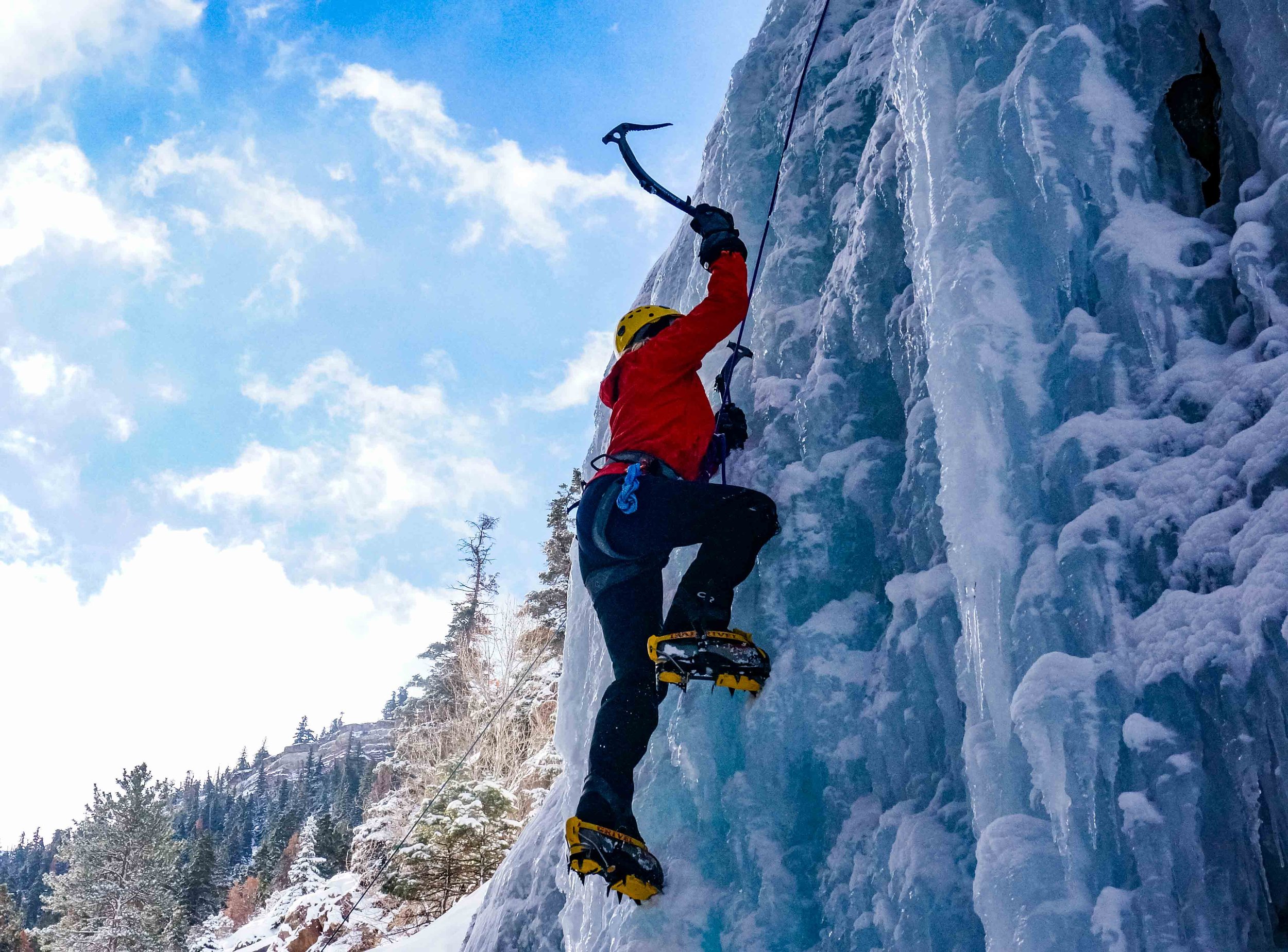
ICe climbing
Ice Climbing Crampons
Crampons for ice climbing vary from basic mountaineering crampons in some important ways. Most importantly are the front point of the crampons. Ice crampons have vertically oriented front points which stick into the ice better and shatter the ice less while kicking in. Ice climbing front points come in dual point or mono (single) point configurations. Dual front points are good for starting out or for wetter, softer ice and mono points are best for more experienced ice climbers as they allow for more pivoting of the ice climbing boot and also shatter less ice than dual points. Other features of ice climbing crampons are that they usually come with a front bail that provides a more secure fit onto ice climbing boots.

The ice climbing crampon on the left differs from the mountaineering crampon on hte right in that it has vertical oriented crampons
Ice Tools
Ice tools could be looked at as simply short, articulated ice axes and that would be basically correct. However, they have some big differences from a mountaineering ice axe that is designed more for self arrest. To begin with, ice tools are shorter and don’t come in different lengths. And, unlike the mountaineering ice axe, they are mainly designed for swinging. Ice tools also have a significant articulated shaft with makes them easier to swing onto steep and bulging ice. The pick of the ice tool has another significant difference in that the pick droops downward on an ice tool while on a mountaineering ice axe the pick curves upward to help when self arresting. The downward droop on an ice tool helps with getting a good stick when swinging into ice and also makes it far easier when removing it from the ice.
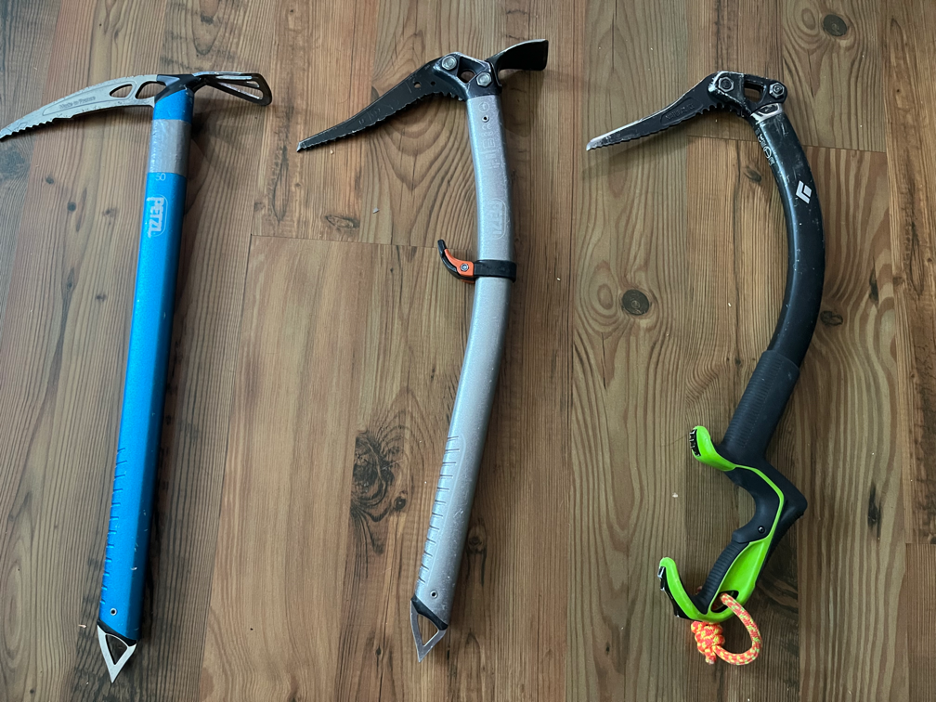
On the far right is a modern ice tool and you can see how it differs from the ice axes on the left
Ice Climbing Harness
Ice climbing harness’ don’t actually differ from rock climbing harness’ are basically the same harness. However, you want to avoid a lightweight mountaineering harness’ that doesn’t have any padding.
Ice Climbing Helmet
Once again, ice climbing helmets and rock climbing helmets are the same helmet. Some people might say that it’s best to avoid the lightest weight climbing helmets as they are not designed to take as many blows as the burlier helmets. While ice climbing its far more possible to get struck on the head by an ice chunk that it would be to get hit on the head by rock while rock climbing. Helmets are an absolute necessity while ice climbing.
Carabiners and Slings for Ice Climbing
Carabiners are the same for ice climbing as they are for all climbing. A good selection of locking and non-locking carabiners are good to have.
Avoid full nylon slings as they do tend to soak up more water. Choose the spectra slings which stay drier. Ice climbing is generally a wet endeavor.
Ice climbing Ropes
Ropes for ice climbing are much the same as for rock climbing except for one key feature….they must have a robust dry treatment. Your ropes will get wet, guaranteed. As for length, 70 meters is the minimum for top roping as many ice climbs are long.

Climbing ropes
Ice Screws
Ice screws are the primary form of protection while ice climbing and making anchors in ice. When starting out its probably best to have 4-5 ice screws so you can at least make an anchor in the ice even if you’re not leading ice yet. Ice screws come in different sizes and for making ice anchors choose the medium to longer sizes.
Ice Climbing Boots
The best boots for ice climbing are insulated single boots designed for winter alpine climbing. The clunky and heavy double plastic boots will suffice for your firs few times on the ice but they’re not the best option if purchasing your own ice climbing boots. And avoid the all-round summer mountaineering boots that do not have the stiffness required for vertical ice climbing. Synthetic “leather” boots are lighter and more nimble for ice climbing.
Make sure you get boots that have a bail slot in the front of the toe area that will accommodate a wire bail found on the better ice climbing crampons

A selection of ice climbing boots and liners
Clothing for Ice Climbing
What to wear while ice climbing is pretty much the same for any winter mountaineering trips. You want to dress in layers of synthetic clothing and shells. This allows you to take off and out on layers as you heat up and cool down. While ice climbing you will be standing around in the shady cold and then exerting yourself and heating up very quickly and possibly sweating a lot. Then cooling down quickly again.
You want to start with synthetic base layers on the bottom and top. Then on the bottom a breathable shell layer which is either highly water resistant or waterproof such as Gore-Tex. On the top you then want a lightweight fleece layer, then a bigger puffy down or synthetic jacket and then a waterproof/breathable shell jacket. You may not actually climb in the puffy jacket but you’ll sure need it when standing around.

A selection of fleece layers and puffy jackets for ice climbing
A warm beanie hat that will fit under a helmet is key. As for gloves, two pairs are good. One lighter pair of waterproof gloves for actually climbing and another bigger warmer pair for standing around. It can be difficult to grip the ice tools with the bigger pair but you’ll need them when not climbing on the ice. Leather palms and fingers are nice as well.
Don’t forget glasses. You’ll need them for ice climbing even if your not in the sun, which you wont be. It’s mandatory to climb with glasses to avoid getting ice shards in your eyes.