
The Allure of Backcountry Skiing & Splitboarding
/Its 815 am on a Saturday after an overnight powder dump in February with blue skies above. In the town of Mammoth Lakes a line of cars snakes their way up Minaret Road towards the Mill and Main Lodge. The lifts start to spin and the lift lines form with eager skiers and boarders hoping to get at least a few turns in fresh powder before it all quickly tracks out.
I however am driving in the opposite direction. The Sherwin backcountry trailhead off Old Mammoth Road is my immediate destination, and my goal is not to hope for just a few feet of fresh powder turns but to see just how many thousands of vertical feet of fresh powder myself and my partner can manage on this bluebird Eastern Sierra powder day. As we roll in to the trailhead four other cars are already in the parking lot with about ten skiers and boarders gearing up for the day, prompting me to comment “looks like it’ll be busy out there today”.
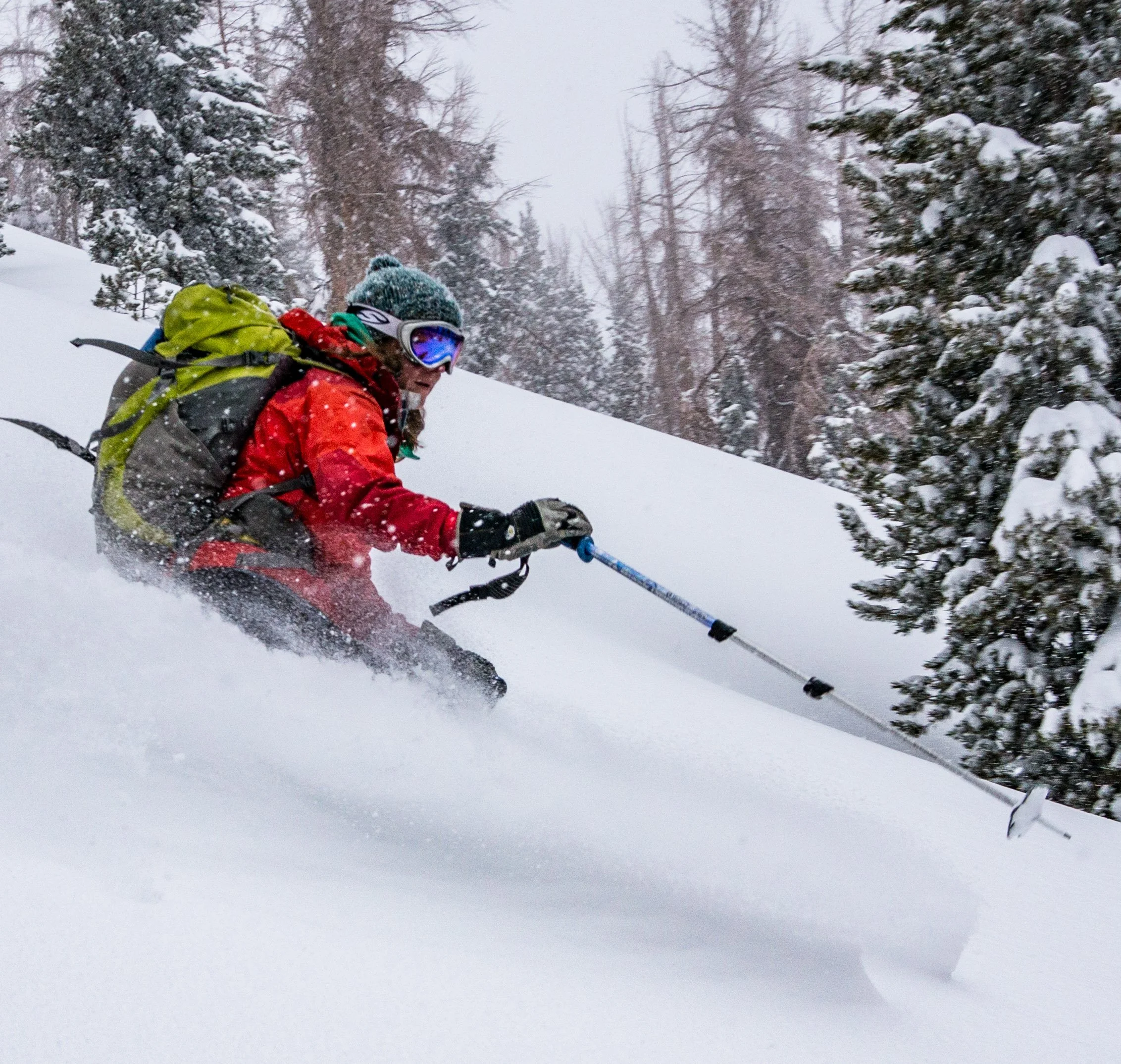
Backcountry powder Skiing in the Mammoth lakes area
After gearing up, we discuss the days plan and avalanche forecast, do a thorough avalanche beacon safety check and then begin to head out towards Punta Bardini and the Sherwin Ridge visible from town. The Eastern Sierra Avalanche Center gives the avalanche risk a moderate rating today which requires us to carefully choose our terrain but opens up our options a bit. With skins on our skis we begin the first of multiple ascents that will take us into untracked powder turns all day long.
This is the allure of backcountry skiing and split boarding. While more physically challenging and with a higher entry “fee” in terms of training and fitness, the backcountry offers a true wilderness skiing experience riding on wild snow. No crowds, the stillness of nature, and if you’re there on a good day, better snow than you would ever expect to see inbounds. Backcountry skiing is quality over quantity. Without the mechanical advantage of chair lifts and gondolas the amount of vertical skied in a day is less, but the experience and quality of the runs are far, far better. For advanced level skiers and boarders, the backcountry beyond the lifts at Mammoth and June Mountain offers an adventurous riding experience second to none.
The tradeoff is elevated risk. No avalanche control, no signs to warn you of hazards ahead, and no ski patrol there in minutes to help you out of a bad situation. In the backcountry you are responsible for managing that risk yourself and to do so safely requires training, experience and a long learning curve. For some though, that adds to the allure.
To first venture into the backcountry you should always have a solid partner, whether a trusted experienced friend or perhaps a professional ski guide. You should also have a good understanding of avalanche hazards, snow stability and weather. In addition, you need to have training in what to do if something goes wrong such as avalanche rescue training. These skills can be found by taking a level 1 avalanche course, many of which are offered right in the Mammoth Lakes area. For most people who may not have a solid backcountry partner and mentor, hiring a professional backcountry ski or split board guide is a solid way to gain that experience.
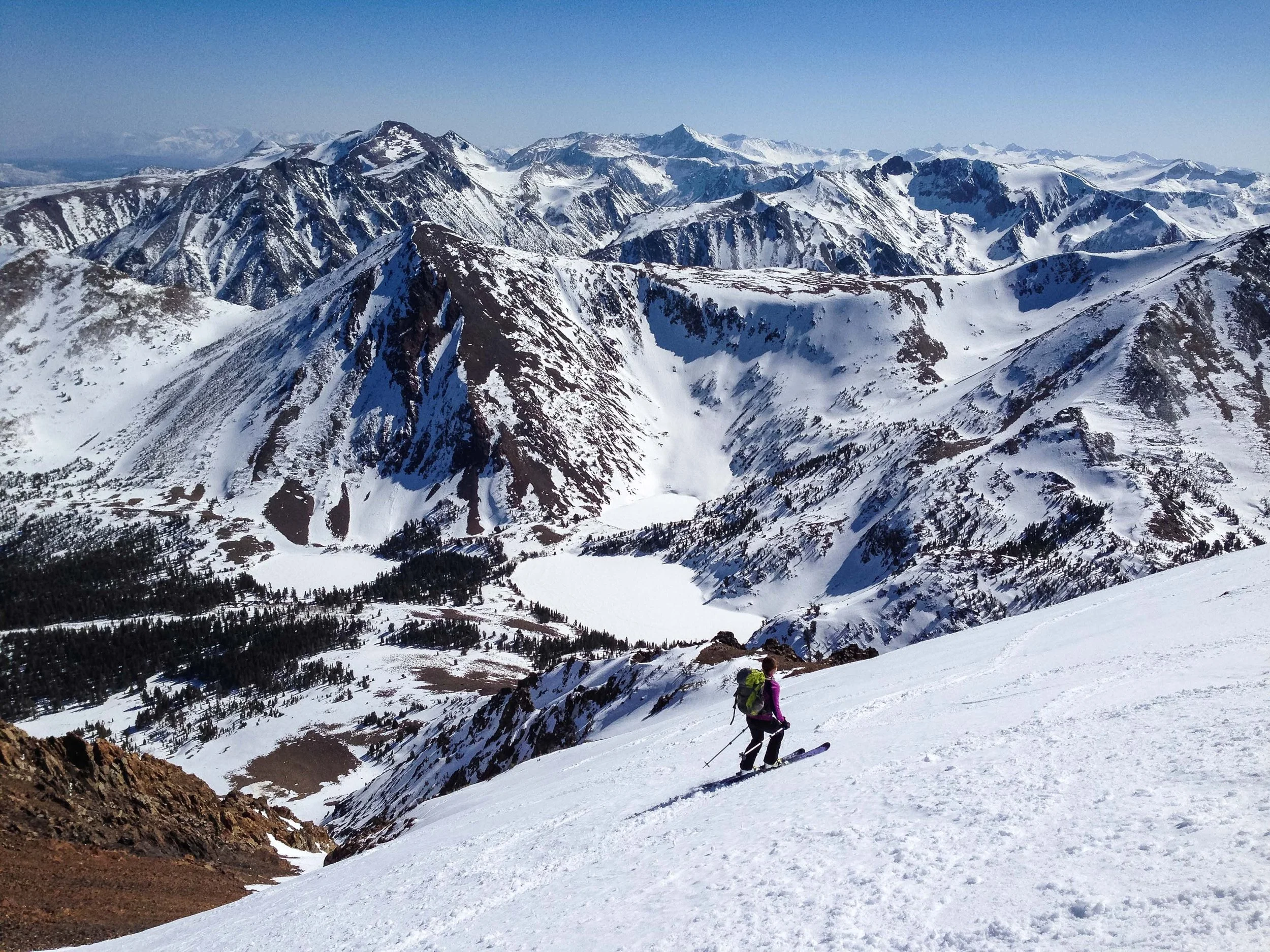
backciountry skiing in the high sierra
The gear is quite different from what you would use at the ski resort. Skis are lighter and generally fatter (for ungroomed snow), boots are considerably lighter and have a more flexible walk mode, and bindings have the ability to release at the heel to allow you to ski uphill, then when at the top the heel locks back in and you ski back down pretty much as you normally would.
Snowboards for the backcountry are very different. The best way to board in the backcountry is with a split board. As the name suggests, the board splits in two for the uphill which allows you to basically “ski” uphill the same as the skiers, then for the downhill the two halves are put back together for the ride down. Bindings are also different in which they rotate for the uphill and are then free heel, then on the way down they rotate back and are the same as a regular snowboard binding. Your normal snowboard boots work great, but some more experienced split boarders prefer hard boots for more serious ascents.
You may be asking yourself, “wait, skiing uphill?”. For both skis and split boards this feat is accomplished with what are called skins. Not actually animal skins (anymore), they are strips of skin-like synthetic material that have a special glue on one side and an animal-like fur on the other side that glides in one direction and catches in the other. They are cut specifically for your model of split board or ski. For the uphill you glue the skin to your base with attachments at the tip and tail and up you go. At the top of your run you rip off the skins and stow then in your pack for the ride down. No, the glue on the skin does not stick to the base of your ski.
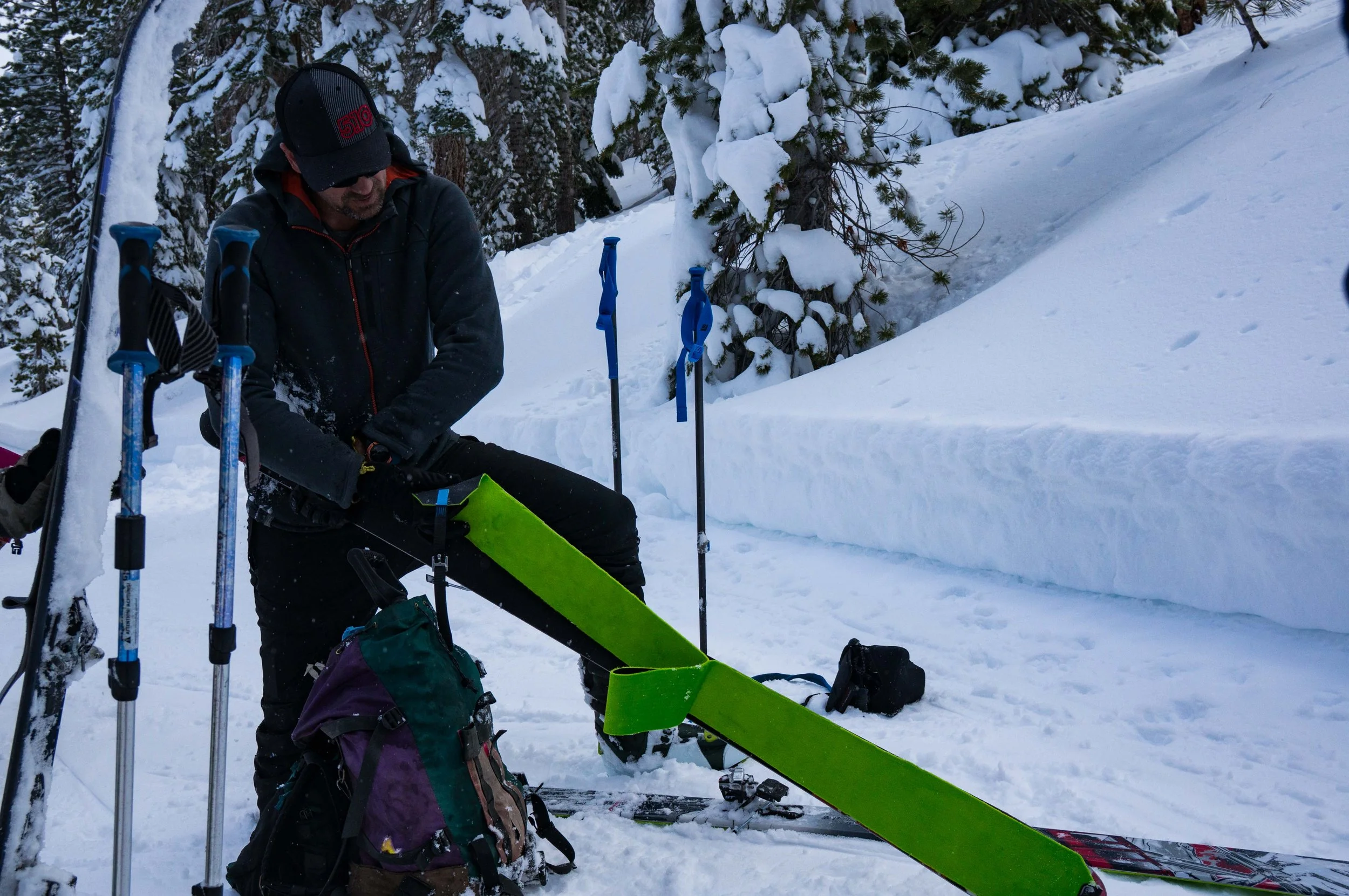
Attaching the skins to a backcoiuntry ski
Other very important gear items for riding and skiing in the backcountry is avalanche safety gear. You simply do not ski in the backcountry without an avalanche beacon, lightweight backcountry shovel and an avalanche probe. An avalanche beacon, or transceiver, is worn on your body and emits a signal than can be picked up by another beacon in search mode to help find a skier or boarder buried in an avalanche. A probe is a long tent pole-like device than can be broken down for stowage then extended and thrust into the snow to pinpoint a buried partner. A shovel is required to dig that person out once located. And of course none of this gear is useful without the knowledge on how to use it. That is where an avalanche course comes in. Even more important than all of this is having the knowledge to avoid ever being caught in an avalanche in the first place and once again that takes avalanche training and experience.
Clothing is a bit different from the resort as well. Dressing in breathable synthetic layers is the way to go as you heat up considerably on the way up and then add layers for the chilly descent. Having the right layers and enough of them is also key to your safety and enjoyment. A small ski pack is also needed to carry all of this gear and clothing as well as food and water for the day.
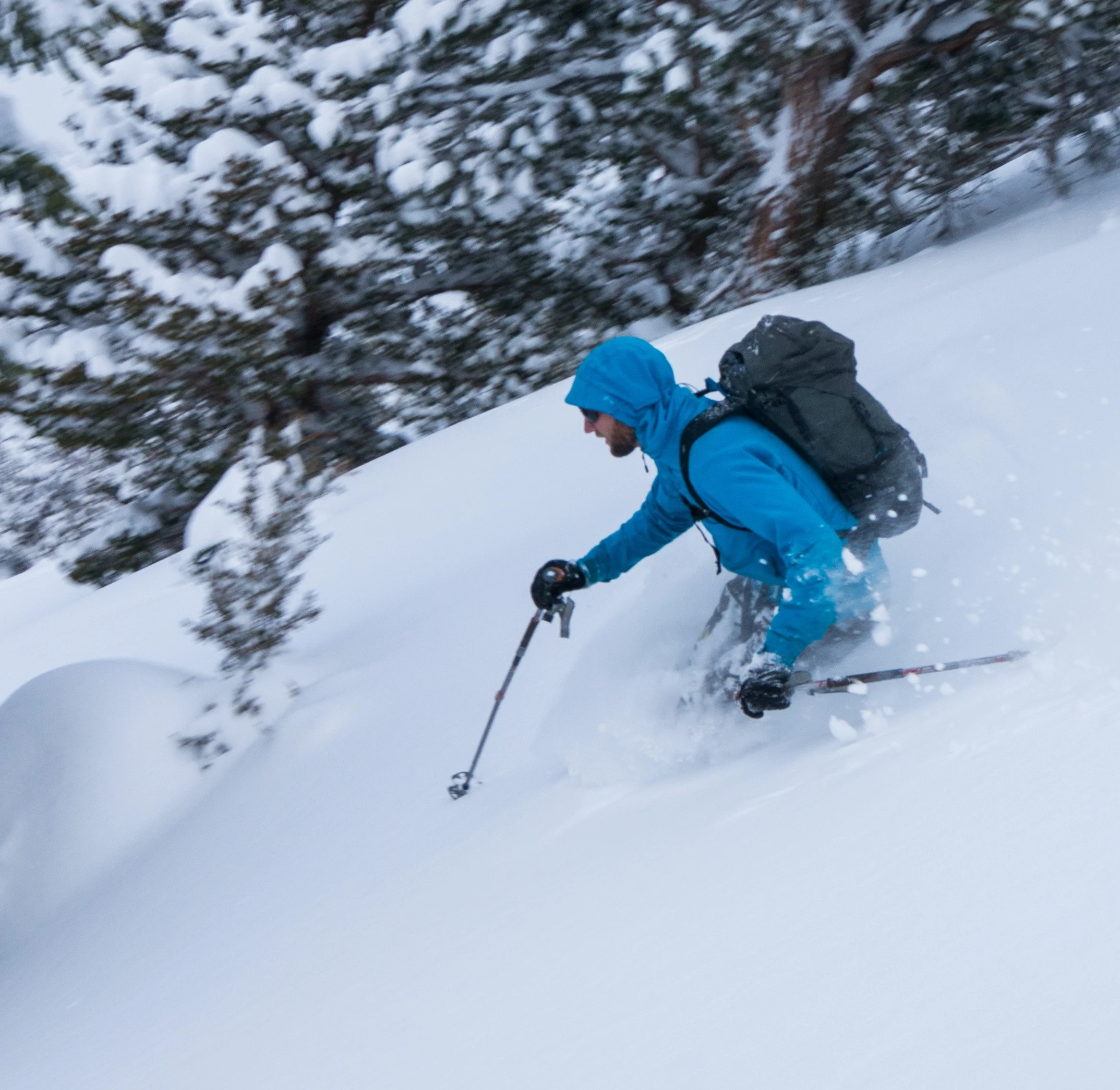
Deep backcoiuntry powder
If all this sounds like a lot of work, it is. The physical demands during a day in the backcountry are far greater than a day at the resort. You need to be in excellent aerobic shape and able to go uphill all day. You also want to be an advanced level skier or boarder at the resort being comfortable on black diamond runs in most conditions. They don’t call it ‘earn your turns’ for nothing, but what a great way to get in a workout while making fresh tracks in the wilderness.
The feel of making turns on that sunny powder day in February was pure bliss. The silence of the skis and the stillness of the wilderness mixed with the muffled whoosh of snow and our occasional whoops of joy. And the tracks made were all ours. Ok, in full disclosure we did cross two other ski tracks at one point made by others with the same idea. At the end of day we safely managed a bit over 5,000 feet of blissful powder turns, even a few face shots, all of which were earned by our own effort and sweat. Later, back in town at the brewery as a ‘good tired’ crept in on us and the legs started to feel a little sore, the well-earned beer tasted just that much better.
Dave Miller is an Eastern Sierra local guide who has been skiing the backcountry around Mammoth and June Lake for the past 30 years. As the founder of International Alpine Guides, Mammoth’s only full-service mountain and ski guide service, Dave is an IFMGA internationally certified ski and mountain guide. When not enjoying the amazing backcountry out his back door, you can find Dave skiing and guiding ski mountaineering tours throughout the Alps of Europe and other ranges throughout the Western US.
International Alpine Guides offers avalanche courses, intro to backcountry ski courses and guided ski tours around the Mammoth/June Lake and Lake Tahoe regions and throughout the High Sierra as well as hut to hut ski tours in the Alps of Europe